The overwhelming majority of USB flash drives you buy are going to come in one of two formats:. The first format, FAT32, is fully compatible with Mac OS X, though with some drawbacks that we'll discuss later. If the drive comes formatted in NTFS, which is the default file system for Windows, you're going to want to re-format the drive because Mac OS X can't write files to NTFS-formatted volumes (at least not without a bunch of extra work that's beyond the scope of this article). How do you tell which format your brand-new USB drive has? Hook it up to your Mac and launch the Disk Utility app, located in your Utilities folder (which is in Applications). Your new drive should appear in the left-hand column, and clicking the 'Partition' tab will bring up info on the drive which includes its current format.
Free Fat32 Format Tool For Mac Os X
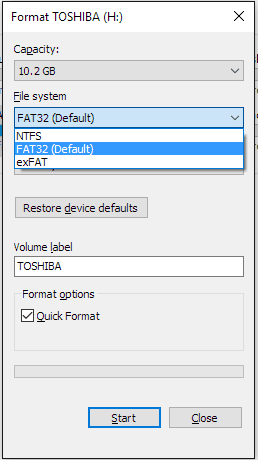
If the drive's format comes up as MS-DOS (FAT) or, less likely, ExFAT, you may be able to simply leave the drive as-is and not bother reformatting it. If the drive is listed as NTFS-formatted, you're going to need to format it to something else if you want full compatibility with Mac OS X.
How to Create an Image from a Excel Spreadsheet. This wikiHow teaches you how to create an image file that you can use in a document or presentation from a Microsoft Excel spreadsheet. Press Ctrl+V in Windows or ⌘+V on Mac. The portion of the Excel document you copied will be pasted as an image in the document. Make a Bar Graph in. Save a chart to a separate picture file that you can embed or add into another program that supports common picture formats, such as.jpg,.gif, or.png. You can also copy an Excel chart to another Office application. Improves the quality of graphics on a web site because parts of the image can be transparent and brightness can be. A fast way to export all of the charts in an Excel workbook as images is to save a copy of the workbook as a Web Page, as in doing so, Excel will create and export image files for you. Excel for mac how to export a graph as an image.
There are several possible file system formats you can use for a USB flash drive, and changing them in Disk Utility is as easy as selecting the number of partitions you want on the drive (usually just one), picking the format you want for the drive, and clicking 'Apply.' Note that this will erase all information on the drive, so make absolutely sure you've got copies of everything before moving forward. Disk Utility gives you five different choices for drive formats in OS X Lion. Unless you have extraordinary needs, you can safely ignore two of them: Mac OS Extended (Case-sensitive, Journaled) and Free Space. I'll discuss the advantages and disadvantages of the other three formats below. Mac OS Extended (Journaled) - This is the default file system format for Mac OS X drives. Advantages: Formatting your USB flash drive this way will give you full interoperability with Macs.
Kindly advice. On the delegator’s Outlook delegate setting, the delegate (assistant) must be listed to have correct delegate permission. Hi WanZhung Bong, Firstly, I’d like to clarify that there are some prerequisites to meet before scheduling Skype meetings on behalf of another user: 1. (You’ve already done this.) 2. Setup skype for online meetings in mac.
It also includes support for features from OS X Lion, such as. You can even if you have the right files, the know-how, and a big enough flash drive, which will allow you to boot your Mac off an external disk if something goes wrong with your built-in drive. The 'Mac OS Extended (Journaled)' option will have the highest degree of support for Mac OS X features, and there's no limit to the size of files you can put on the drive.
Cheddar powder mac and cheese. The powder easily mixes with milk or water to make a sauce. It tastes pretty standard to boxed mac and cheese; maybe not exactly just like the blue box but pretty close (and not necessarily worse, just slightly different). Other than the cheese powder, my homemade instant mac and cheese recipe calls for just three ingredients: butter, milk, and pasta. You can add as much cheese powder as you want, and use any shape. This ingredient is a game-changer for making a quick batch of extra-cheesy mac and cheese. Gone are the days of making a roux to form the base of that creamy cheese sauce. Instead, just as you would with the boxed version, the cheese powder is mixed with milk and then stirred into a pot of the cooked, buttery pasta of your choice.